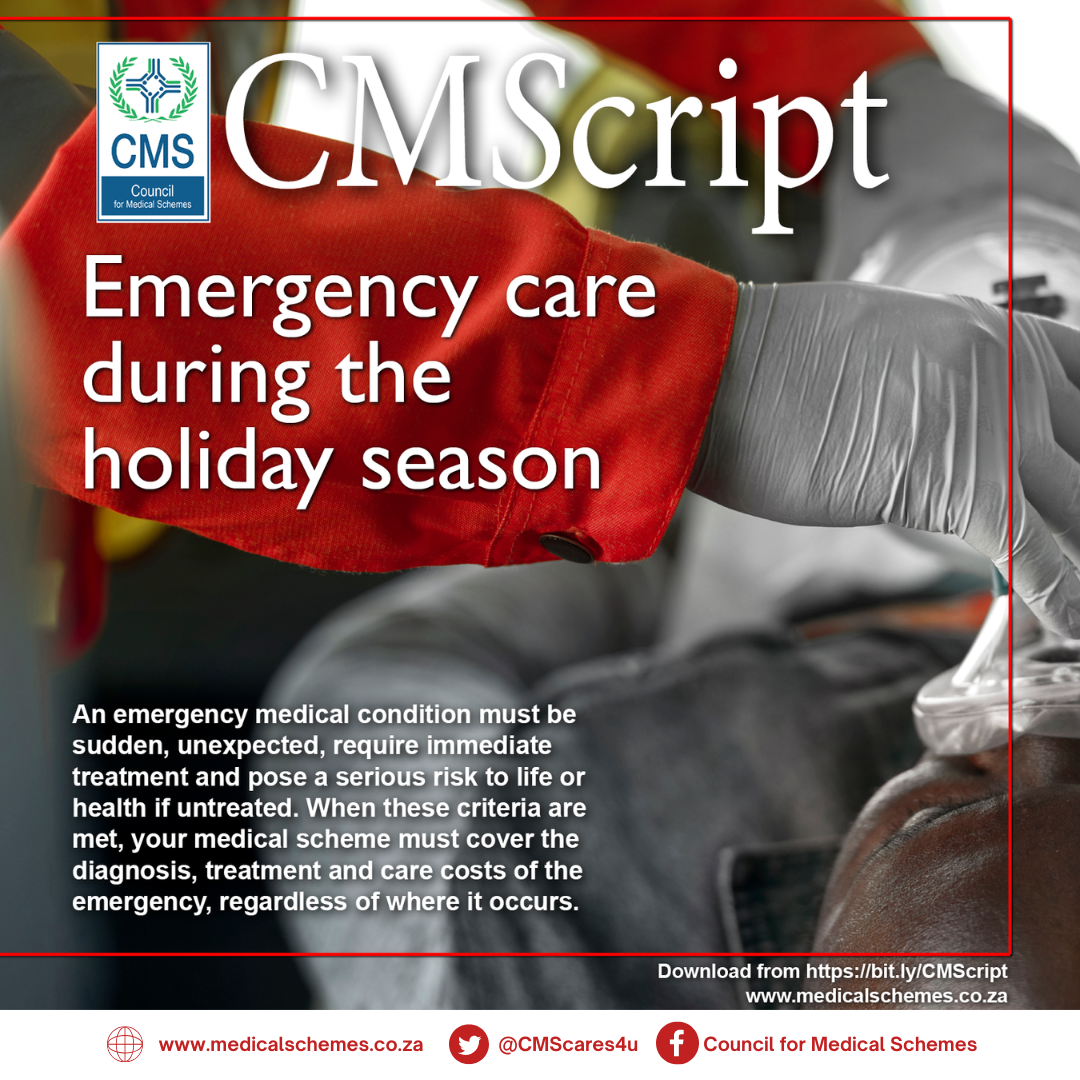
CMScript 13 of 2025: Focus on emergency care during the holiday season
It is December, and many of us will be on the move as it is the season for road trips, family gatherings and celebrations. With all the excitement in the air, it is easy to forget that accidents and medical emergencies can happen without warning.
During this period, it becomes especially important for everyone to understand how medical emergencies are covered by medical schemes and what the Prescribed Minimum Benefits (PMB) regulations guarantee. Knowing what qualifies as an emergency and what to expect when seeking urgent care can make a significant difference in those critical moments.
What is an emergency medical condition?
An emergency medical condition is a sudden, unexpected onset of a health problem that requires immediate medical or surgical treatment.
A condition is regarded as an emergency only if all of the following apply:
- The health problem happens suddenly and without warning.
- Immediate medical or surgical treatment is required.
- Without urgent care, there is a serious risk of:
- impairment of a vital bodily function (such as breathing or brain function),
- dysfunction of an organ or body part (such as the heart, kidneys or limbs), or
- a serious threat to life.
Examples of emergency medical conditions may include severe chest pain suggestive of a heart attack, major injuries from an accident, difficulty breathing, sudden weakness on one side of the body (possible stroke), or severe internal bleeding.
Emergency care and PMB entitlement
Prescribed Minimum Benefits (PMBs) are a set of guaranteed healthcare benefits that ensure all medical scheme members have access to essential treatment, no matter which option they belong to. PMBs include:
- Any emergency medical condition
- 271 defined medical conditions (Diagnosis Treatment Pairs)
- 26 chronic conditions (Chronic Disease List)
Medical schemes may require authorisation for PMB conditions. However, in an emergency:
- Schemes may not refuse benefits simply because authorisation was not obtained before treatment.
- Authorisation should generally be obtained within 48 hours of the emergency event.
- Both members and healthcare providers play a role in ensuring accurate assessment by the scheme. This includes:
- Using the correct ICD-10 codes on claims.
- Providing relevant clinical information.
Emergencies do not always happen close to a hospital or a Designated Service Provider (DSP). Over the holiday season, people often travel to remote, rural or unfamiliar areas. The Regulations to the Medical Schemes Act confirm that emergency care can be provided in any clinically appropriate setting, including:
- Emergency or casualty units;
- Clinics or smaller facilities;
- Any location equipped to provide urgent care.
In a true emergency, go to the nearest appropriate facility without delay, even if it is not a Designated Service Provider (DSP). Stabilisation comes first, authorisation can follow.
Tips for this holiday season
- Know your benefits: Review your scheme rules and keep your medical scheme card and emergency number with you.
- Seek help immediately: In an emergency, go to the nearest appropriate facility, do not delay medical care to find a DSP.
- Ask questions: Check with the doctor if your condition qualifies as an emergency and understand the treatment given.
- Keep records: Save accounts and medical documents in case of a query.
- If payment is declined: Ask for written reasons and if you disagree, you may lodge a formal complaint with the Council for Medical Schemes. Read more on the CMS complaints procedure here.
A little preparation can make a big difference! Save your medical scheme’s 24-hour emergency number, travel responsibly, and carry your medical scheme card and medication.
Download the full CMScript here.